Complementary Tools to Chromatographic Analyses for Better Biomass Characterization
13 mai 2026
Complementary Tools to Chromatographic Analyses for Better Biomass Characterization
By Annabelle St-Pierre, researcher, Innofibre
Innofibre has two analytical instruments that allow molecular separation in a sample through chromatography: a high‑performance liquid chromatography system (HPLC) and a gas chromatography system coupled with mass spectrometry (GC‑MS). These two complementary instruments are powerful analytical tools frequently used at Innofibre to characterize the molecules that make up biomass. They enable the separation, identification, and/or quantification of compounds within a complex mixture.
Liquid chromatography separates molecules that are soluble in a solvent based on their polarity and affinity for the mobile phase (solvent). Gas chromatography, on the other hand, separates volatile and semi‑volatile compounds according to their different levels of volatility. Thanks to the mass spectrometry detector, GC‑MS can potentially identify compounds by comparing their spectra with reference spectra in databases.
In recent years, Innofibre has acquired complementary equipment that increases the versatility of these analytical instruments. These additions are described below.
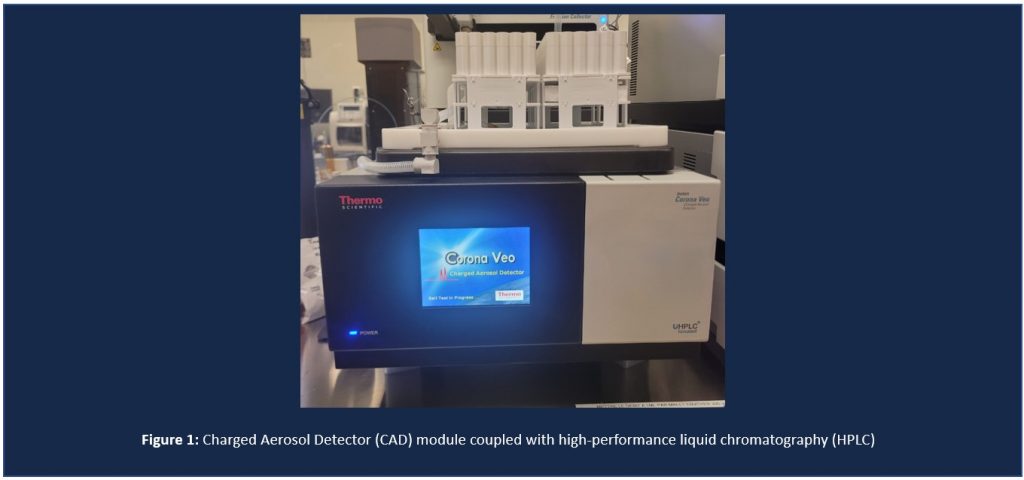
The Charged Aerosol Detector (CAD): a detector that sees everything
To analyze a wider range of compounds by HPLC, Innofibre acquired a charged aerosol detector (CAD), a complementary detector to the more conventional diode array detector (DAD). The CAD’s operating principle is simple: the eluent is first transformed into fine droplets (nebulization). These droplets, which contain the molecules to be analyzed, are then dried and positively charged. The detector measures the charge of these particles, allowing quantification of the compounds present in the sample.
This detector offers several advantages over the DAD. The DAD only detects compounds that contain a chromophore—that is, molecules with a chemical structure capable of absorbing UV‑Visible light. The CAD, however, detects everything, because any molecule can be charged through nebulization. This makes it particularly useful for analyzing compounds that conventional detectors struggle to detect, such as sugars or certain organic acids.
As a result, the CAD makes HPLC more versatile. At Innofibre, this equipment allows us to quantify cellulose, hemicellulose, chitosan, free sugars (glucose, fructose, galactose, etc.), and much more in various types of biomass.
Size‑Exclusion Chromatography (SEC) Columns: separating differently with the same instrument
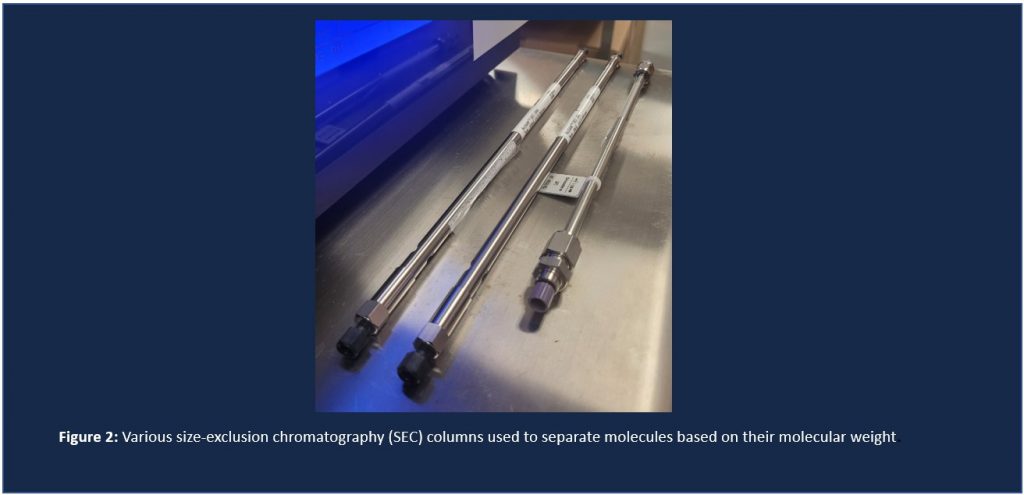
Innofibre has also acquired specialized columns for size‑exclusion chromatography (SEC). SEC is a broad term that simply means separation is based on molecular size rather than polarity, as in “classical” chromatography. One can imagine SEC columns as being filled with beads that are hollow and full of pores. As the sample passes through the column, larger molecules do not become trapped in the pores and are eluted first, while smaller molecules are retained longer.
SEC columns are well suited for analyzing macromolecules such as lignocellulosic polymers, proteins, plastic polymers, and more. The technique is compatible with sensitive molecules because it does not cause denaturation. SEC also makes it possible to analyze complex formation, detect aggregates, and obtain a profile of molecular size distribution within a sample. This is particularly relevant when evaluating the efficiency of a polymerization reaction or the effectiveness of chemical or enzymatic hydrolysis on macromolecules.
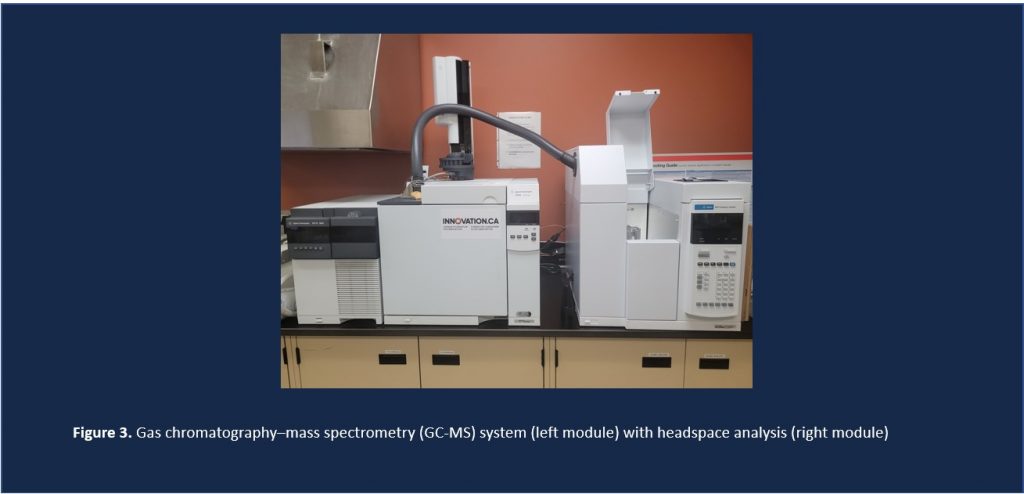
The Headspace Module: a simplified way to analyze highly volatile compounds
Finally, in 2023, Innofibre acquired a headspace (HS) module to complement the GC‑MS system. The most common way to inject a sample into a GC‑MS is liquid injection. This requires the sample to be a filtered liquid or an extract obtained from a solid sample—steps that are often time‑consuming and require precautions to avoid degrading the molecules.
When analyzing highly volatile compounds, headspace injection is an attractive alternative. HS injection requires far fewer preparation steps: the liquid or solid sample is simply placed directly into a vial. Of course, the solid sample itself is not injected into a 0.2 mm‑diameter column! Instead, the HS autosampler collects the air above the sample—the air in the vial’s headspace.
This approach allows efficient analysis of volatile compounds without directly introducing solvent into the column, which helps protect it. This type of injection is particularly useful for analyzing residual solvents in materials, aromatic compounds in fragrant plant biomasses, or emissions of volatile organic compounds (VOCs) from various materials.
A diversity of equipment for a diversity of industries
In conclusion, Innofibre has integrated these three complementary analytical tools into its characterization systems to expand its analytical capabilities. These additions make it possible to analyze a wider variety of compounds, including non‑volatile molecules without chromophores, polymers, and highly volatile compounds. With these improvements, analyses become faster, more reliable, and more versatile, strengthening Innofibre’s ability to meet the diverse analytical needs of businesses.